

and related: Kiliś, Kostewicz, Pawelski, Sadlakowski, Wyrzykowski...
and related: Kiliś, Kostewicz, Pawelski, Sadlakowski, Wyrzykowski...
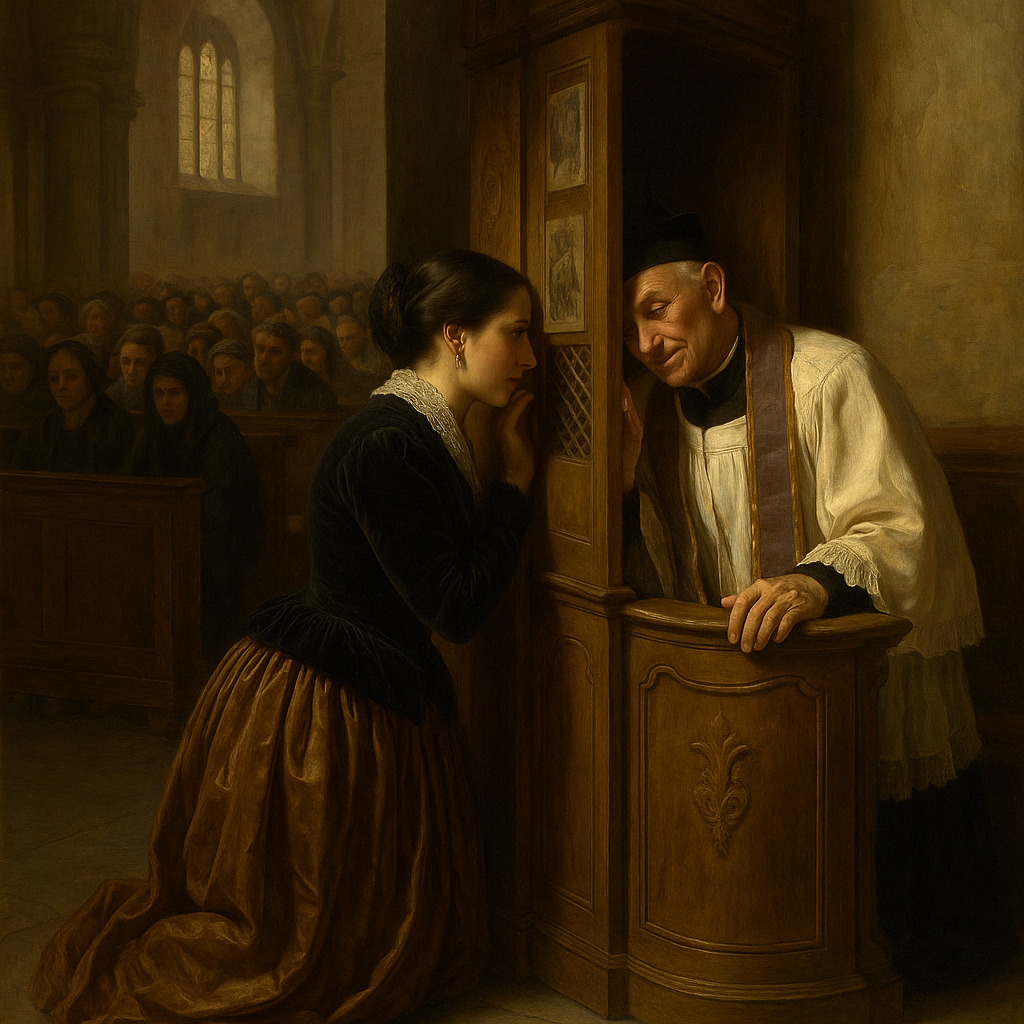 "No, Reverend, I have not spoken with him," confessed the young woman, kneeling by the confessional grille. "I knew not how to begin such a discourse. His mother has been gone more than a year."
"Daughter, thou lackest courage to speak with thy husband of his mother, yet hast thou the boldness to weave such dire conjectures?" replied the voice from within.
"The moment I found it, I straightway, after reading, hid it deep away. Only later did it begin to trouble me. For that woman dealt in magic. Is that right? The Church forbids it!" Marianna burst out, clutching the edge of her shawl.
"But what dost thou know of magic? Thou sayest thy mother-in-law sought to lift a curse, desiring no harm to any..."
"Aye, but she used magic," the woman insisted, undeterred.
"Daughter, what dost thou know of magic?" the priest interrupted. "Thou sayest thy mother-in-law wished to remove a curse without harming a soul. Thou knewest her not, knowest not what she feared. Perchance she besought the angels’ aid, or perchance ’twas but clumsy attempts. Whence canst thou tell? Thou hast not even asked Łukasz!" explained Father Moczulski, who, having served in Pomiechowo for years, knew both Orszula and the secrets of the Kilisi family that fueled this emotional struggle.
"How can I speak with my husband when he knows not I have this book? He hath no inkling of its existence, nor perchance of this whole curse upon them," she whispered, feeling the weight of her secret.
"Dost thou hear thyself? Thou art a good woman. Must I teach thee how to converse with thy husband? Go now!"
"And must I pretend naught hath happened?"
"Maryśka!" the priest exclaimed, so loudly that the nearest women turned with curiosity. Marianna, too, realized that not only the priest’s raised voice but also the length of her confession was arousing unhealthy interest among the churchgoers.
"Very well, Reverend, I shall speak with Łukasz," she replied—not from certainty in the counsel’s wisdom, but from a desire to flee the place swiftly.
"Now repent of thy sins, and I shall grant thee absolution. Deus, Pater misericordiarum, qui per mortem et..."
When Marianna heard a tap on the confessional wall, the Mass was nearing its end. Rushing to the altar, she managed to receive Communion. Thus, she missed the curious, sometimes mocking glances of her neighbors, who, noting the long time Kilisiowa spent at confession, suspected some grave transgression. Kuczeńska, of course, wore the most triumphant look—a woman long harboring open dislike for Marianna, now seeming to say, "Behold, she who ever played the saint—now what?!"
The journey home took the Kilisis little time. After leaving the church, they wasted none. True, Łukasz’s kin were present at Mass, but the two branches of the family had not maintained close ties for over a year. One cause of this rift was the division of family property. Łukasz, marrying at merely twenty, received but a small portion of the estate remaining in nearby Czarnowo.
His father, Michał, died in September 1829, less than a year after his son’s birth, having lived but thirty-nine years. Since his mother’s death, not yet two years past, the eldest child, Jan, had already begun to feel the master of the remaining holdings. Little was left for the younger siblings.
For Łukasz, this was a bitter time. Raised without a father, he had centered his familial affections on his mother and elder siblings. They had been his guides and models in life. Now he felt cast off and wronged. His world of principles and norms crumbled. Moreover, there was that incident at the wedding...
The road from Pomiechowo to Kosewo took no more than half an hour, but the Kilisis still hastened. Their horses awaited, and the servants, too, wished to reach church on Sunday.
Riding in the pleasant July sun, the Kilisis discussed with Marianna’s parents the press of current affairs and those to come by August 6th. Each year, young Kilisiowa made the foot pilgrimage to Jasna Góra. Hitherto, no illness had deterred her, not even lately her tiny daughter. Thus, it was clear they must settle duties and assign roles, for one pair of hands would be absent from the homestead.
Marianna’s parents, the Matyasiaks, were a family newly settled in these parts but already prosperous. Part of their wealth passed to the young couple, combined with Łukasz’s portion, allowing them a relatively high standard of living. Their home, dubbed a manor since Marianna’s marriage, stood opposite a small lake in Kosewo and was still recalled a century later as grand and notable. It was a wooden structure of heavy timbers, six rooms, with a cellar, shingled roof, spacious hall, and storage cellars. At its center rose a broad hall, with a wall opening closed by a wooden shutter.
In this house, besides the Kilisis and essential servants, dwelt the Matyasiaks and their two daughters, Frania and little Agnieszka. Around toddled one-year-old Cecylia, Łukasz’s sole child thus far, and soon this circle would grow, for Marianna was again with child.
Łukasz’s life seemed ordered as many might dream—yet something gnawed at him inwardly, poisoning his dreams and hindering full enjoyment of each moment. Living in Czarnowo, he was the son of a noblewoman, residing in a manor, cherishing the past of his lineage. Daily life, indeed, mirrored that of other local farmers—each day filled with toil on the land. Nobility excused naught but fostered a sense of shared values and a prescribed demeanor. He recalled not his father, but his mother oft pointed to the saber on the wall, saying, "A nobleman ought not so act."
Of his ancestors’ migration from the north, none spoke now. Yet they stubbornly recalled that the family’s first homeland was Lithuania, whence "we once came." All household tales aimed to preserve identity and a certain distinctness. The Kilisis lived among people but apart, always sensing an inexplicable otherness. Now, through his doing, this ended—a paradox, for he, the child closest to family traditions, wondered if he could bear this torch of memory among those to whom such feelings were alien. His alienation from kin after marriage deepened his longing for a mythic past. Yet that past would soon return in the most unexpected manner.
Marianna delayed not. True to her promise to the priest, she resolved to broach this difficult talk after Sunday dinner. Having arranged her thoughts, she meant to draw Łukasz for a long walk in the orchard but found herself outdone by her daughter and sister. Her husband, unaware, had taken both girls for a Sunday stroll. Undeterred, she set out to find him. The search was brief, for beyond the nearest buildings stretched a long orchard of apple, cherry, and pear trees. Under one, on an old blanket, sat Łukasz, with two small figures playing in the grass. They were not alone—nearby, Frania, Marianna’s second sister, munched on sweet, seasonable apples.
The woman waved cheerfully to her husband, who, spying her hastening toward him, rose with open arms, expecting a warm embrace from this girl who, beside him, seemed a mere child: youthful features and slender frame suited her short stature and untidy blonde locks. He was not disappointed.
 "Come home, I must speak with thee," she said.
Łukasz showed surprise, then gazed at her with a teasing smile, scooped up both girls in his long, bony arms, and they all headed toward the buildings. "And whither goest thou now?" cried Frania after them. Receiving no reply, she turned to her sister:
"Takest thou him again?"
Marianna merely waved, not turning her head. Spotting Anka, the household help, she called:
"Oh, good thou art here. Take the children to their grandmother and ask her to mind them an hour."
Moments later, free of duties, they went to the side door leading to their part of the house. These doors, scarce two years old, were fitted by Mr. Józef Matyasiak after his daughter’s marriage, when the young couple, contrary to prior plans, settled in Kosewo. Further works were planned, for the layout was inconvenient—entry led straight into a room. Only a small overhang and a large flat stone before the threshold shielded the interior from eternal mud. Soon, some expansion was due. What? None yet knew, but "something must be done," the elder host oft said.
Marianna drew her husband to an old piece of furniture and, with a gentle push, seated him in a rocking chair of yore. Kneeling on a straw mat, in the glow of an oil lamp lighting the room, she asked:
"Łukasz, dost thou know that nigh two hundred years ago another Marianna sat thus by her husband, and that ’twas even in thy family?"
"Perchance ’twas so. Was she of that name?"
"Aye, but she was thy great-great-great-grandmother..." she added softly, gazing into his light-blue eyes.
"I heard naught of this," he replied, then brightened. "Whence knowest thou?"
"I know more than thou thinkest," she teased, a gleam in her eyes hinting at secrets. "Thou hast oft said thy line came from Lithuania, but dost thou know when and why?"
"None spoke of it," he shrugged. "Likely they knew not themselves."
"Oh, some knew, surely," she whispered, lowering her voice as if fearing eavesdroppers.
"Hey, thou mischief, what hidest thou from me?" he quipped with a smile, though curiosity laced his tone.
"Patience, husband," she replied, settling on a low stool that creaked under her. The room smelled of dried mint, and July sun filtered through shutter gaps. "Recallest thou how, after our wedding, we rummaged in the attic of thy manor in Czarnowo?"
"I have a small surprise for thee, but thou must be patient," she said, sitting on a nearby stool. "Recallest thou how, soon after our wedding, we played in the attic of thy manor in Czarnowo?" she asked, nervously clasping her hands.
Łukasz furrowed his brow, trying to recall those recent days, but she continued without awaiting reply:
"I went there again later, alone. Beneath a layer of straw, I found an old notebook—nay, a yellowed book, writ by several hands. Therein was all about thy kin."
"Why showedst thou it not to me? Where is it..." Łukasz leaned forward, curiosity flashing in his eyes.
Marianna raised a hand to hush him, not letting him finish.
"First I sat to read, out of curiosity. I wished to know all of thy family, and there were things I ne’er heard. Someone must have hid it, but I knew not why nor who. Only later, after reading of thy forefathers, did I see the book hid a dire thing. The writings spoke of misfortunes befalling the Kilisis each generation, as if a shadow hung o’er the line. There, within... that is, in the book, thou knowest..." she babbled incoherently.
"Did someone challenge another to a duel?" Łukasz jested half-seriously, a flicker of unease in his eyes beneath the smile.
He jested, yet unease tinged his voice, poorly masked by humor. Meanwhile, his wife’s words flowed like a river’s current. She began telling of the Kilisi siblings’ flight from lands once part of the Commonwealth, now nigh forgotten— of hope for a new life, yet longing for their homeland and kin left beyond the Dvina. She spoke of another flight, this time orchestrated by Stanislaus Kilis, and how he reached Mazovia.
"’Tis why thy grandfather Walenty was born in Goławice."
"Walenty was said to be son of Andrzej and Katarzyna, but knowest thou what? I heard of Kilisis from Łomna," Łukasz interjected.
Mania pressed on: "Perchance some branch settled there. I know naught of it, but what matter?"
"Thou saidst they ‘fled.’ From what fled they?" he pressed, frowning.
"From a curse," she whispered, her voice trembling as if the word bore a chill. "The writings spoke of an ancient shame, of a maid from Lithuanian woods whose heart was broken. ’Tis said she cast words bringing ruin upon the line..."
"A curse? Maniusia, hath Anka been spinning thee tales?" Łukasz leapt from the chair, yet a shadow of unease flickered in his eyes, as if he sensed a deeper truth.
"Fool!" she retorted, then softened, laying a hand on his shoulder. Her eyes gleamed in the oil lamp’s light, as if she feared her own words. "Hear me, Łukasz. The book speaks of an old wrath from Lithuanian woods that followed the Kilisis. ’Tis no tale, but a shadow that haunts thy line," she whispered, and a chill from the July evening crept through a shutter gap.
Marianna realized her vehemence might deter further talk. Recalling tricks that ever worked in such moments, she lost some time but soothed him, guiding his thoughts anew. Twice the cry of little Cecylia, borne by Anka from the hall, interrupted, but each time Marianna sent her to the grandmother. Łukasz, in the rocking chair, grew darker with each moment. At scarce twenty-three, he was unprepared for the weight of his wife’s tale. Her words of a curse, of ancient wrath from Lithuanian woods, cast a shadow on his mind like smoke from a dying hearth.
Never had he pondered why so little was told of bygone times and folk who lived before him. Aye, he knew some tales of his grandfather Walenty, born nigh a century past, and his wife Małgorzata. He knew she had a son, Franciszek, from her first marriage to Szymon Pietrak. Once he visited other kin in Goławice. Grandfather Walenty, besides Michał, had a son Antoni, whose offspring mostly stayed on family lands, though Uncle Stanisław settled in Studzianki.
Curiously, soon after his second son’s birth, Walenty Kilis vanished, returning years later with his left eye gone, a great scar from brow to chin, and a uniform packed deep in his knapsack.
"Once I overheard a talk," Łukasz recalled. "Mother spoke with someone, thinking none heard. She said her father-in-law’s soldierly soul awoke, and he fought in another uprising. He returned not. His son, my father, ne’er fought, for, as thou knowest, he died young. Yet he chose a wife to honor our forebears."
"Speakest thou of Orszula?"
"Aye, during Napoleon’s retreat, he wed Grandmother Orszula, daughter of Mateusz Kurpiewski from Czarnowo."
The choice was likely no accident, for Mateusz, dying in 1808 from wounds sustained in the 1806 battle by the Narew against the Russians, left a legacy. Both Łukasz’s parents were children of Polish soldiers. In their few years together, they bore eight children. Born October 7, 1828, in Czarnowo, Łukasz was the youngest.
"Well, Father died not from some curse, I trow," Łukasz jested.
"Nay, but recallest thou thy sister’s behavior at our wedding?"
"Mania, mind that she oft acted strangely..."
"’Tis not that," she cut in. "Such cases have occurred in thy line before. The first was said to be in the 15th century, still in Livonia, when a woman cursed them. ’Twas her vengeance."
"Vengeance? For what?" Łukasz pressed.
Marianna knew she must tell the truth plainly, or he would either not grasp it or feign ignorance. Expecting anger or denial when she finally unburdened her heart after over a year, she met neither. Łukasz fell silent, as if awaiting more or some accusation. He did not deny.
"Thou knewest..." she whispered after minutes, alarmed.
"Nay, Maniusia, I knew not the whole tale, though much pointed thereto. Why keptst thou this from me so long?"
"’Tis writ that only one may know the curse. The father passed the writings to one son, and so it went through ages. Thy father died young, and after him, thy mother found the book. Alas, she sought to end the curse with magic. For years she tried spells, ne’er knowing her efforts failed. She hid it in the attic and told none till her death. When I found it, I knew not if I should speak."
"Why?"
"’Tis not just the curse—methinks none should know thy mother dabbled in magic. ’Tis evil!"
"Janek, my eldest brother, once said Mother visited some hag, but we thought her a herb-woman."
Their talk was broken by a shadow passing the window.
"We must pause," she noted, spying Anka through thick curtains bringing their daughter. "We’ll speak at night."
Łukasz minded not the interruption—nay, he seemed glad for time to ponder this new knowledge. Or perchance ’twas no new thing—had he not long sensed something amiss, first fleeing to solitude, then to his in-laws?
Marianna felt great dissatisfaction. For her, the curse itself, nor its dire effects, was not the chief trouble, but how her mother-in-law sought to address it. Though young, she lived by a faith deeming sorcery a grievous sin. To her, any magic equated with Church-condemned witchcraft, and she could not reconcile the kindly woman of tales with the child-hunting witch of legends.
’Twas nigh nine when he left wordlessly. Close by, beyond the road, lay his place of musing. By a small village lake, flanked by reeds, with dark willow outlines on nearby meadows, none came at this hour. Łukasz could be alone with his thoughts. The news that struck him today was dreadfully disheartening. Family troubles he knew well—where were they not? Every family hid some scandal, some secret in its nest. The Kilisis in Czarnowo, though newcomers from Goławice, earned respect. True, part stemmed from their wealth...
Yet none could deny that the names Kilis and Kurpiewski were linked with honesty and neighborly kindness. The home atmosphere Łukasz knew from early childhood and his siblings’ tales shaped him after the ideals of a Pole—loyal son of country and Church. Łukasz simply wished to be, and only be, worthy of his grandparents, of whom he knew little, but that little molded his character.
His father’s absence came early, but Orszula distinguished not her family. In her tales to her children, she spoke of the Kilisis as "in our family..." Of her own forebears, she said "in my family..." Thus, Orszula nurtured noble traditions in a now-impoverished line, praying with her children, beginning each with "Vardan Dievo Tevo ir Sunaus, ir Šventosios Dvasios..."—for "’twas ever so with us." Oft escaped her a Lithuanian "ne" for "nay."
The family crest, carved in old wood above the door—now above Łukasz’s hearth—Orszula also tended. Its cleaning, or pre-holiday dusting, was near a rite, like that of many holy images.
When she died in February 1848, the house slowly worsened. The spirit of unity faded, replaced by rivalry and concern for "one’s own." Jan Kilis, Łukasz’s eldest brother and heir, did no wrong, but Łukasz oft felt he must find his own place. He saw an era end—not just in his life, but in his line’s history. Could he, with so little knowledge, fueled only by nostalgia, meet these challenges and pass tradition to his children? This question returned oftener.
From deep reverie, his wife’s voice roused him:
"Łukasz, why hidest thou so?"
"Well, Maniu, thou gavest me much to ponder today," he replied with a smile masking a different mood.
"Oh, fret not, we’ll manage all," she said lightly, taking his hand. "Come, let’s run the meadow!" she teased like a child.
"Methinks thou forgettest something," Łukasz chuckled. "Thou canst not," he added, touching her belly, soon to bear their second child.
"Oh, I’m a fool," she blushed, but unwilling to return home, drew him to an old, thick willow.
They sat beneath, embracing yet silent, each lost in thought. Yet they were together. This pair was unique—youthful, expressing childlike needs, yet grave in weighty matters.
When they reached home, they spoke no more of the found book or its tales. Only in early August, as Marianna prepared for another pilgrimage, did Łukasz revisit the thread.
Entering his in-laws’ home seeking Maryśka, he knew patience was needed. His wife, with Anka, bent over two great shredders, swiftly slicing cabbage heads whose fine bits fell into a wooden tub. The shreds must be thin, for the hostess held only such guaranteed the delicate taste of cabbage soup or bigos. Mrs. Matyasiak, preparing dinner, every few minutes handed another cabbage to the girls.
This sight was unusual. Marianna, the pregnant daughter, and Anka, the help, worked together, jesting merrily. Of similar age, they had played since childhood. That one now served the other changed naught in their bond. More formal ties linked Anka to Mrs. Matyasiak, yet she treated her worker fairly.
Łukasz, watching, knew the book was not soon his. After shredding, the cabbage must be packed in barrels. In villages, this oft meant treading with feet till juices flowed—unthinkable at the Matyasiaks’. Large wooden pounders, like sturdy clubs, were fetched from the cellar for the men to use once the women finished. Łukasz had been pressed to this task last year. ’Twas no joy, but he knew escape was none. Thus, only late that eve could he tell his wife he wished to read the book entire.
"Methinks I’m ready to read what thou foundest," he said to her. "With so many days alone, I’ll read in peace."
Kilisiowa protested not. She saw ’twould be good time for Łukasz to read and grapple with its contents. Though she oft treated him like a playmate, she grew into her role as wife and mother. He wanted the book—his family’s own. She could not, even if willing, argue.
"Read, read," she tossed to him, handing a bundle wrapped in thick cloth, drawn from a great wooden chest by the wall. Łukasz seized it eagerly, unwrapping it. At times, he reread passages, absorbing each penned word.
Meanwhile, Łukasz again delved into the book’s hard-to-decipher text:
“Karola stood in the doorway, leaning heavily on the frame. Leszek’s narrow room, though poor, was warm and, despite all, cozy. A jug stood on the table, steam rising from a mug, a modest fire licking the hearth’s blackness. The woman, though aged, moved with a certain dignity honed by years of service. Yet this time, no calm—her daily wont—was in her.
— ‘Art thou here, Leszek?’ she said, entering unbidden. Her eyes gleamed with anger, her face lined with deep wrinkles. ‘I must speak with thee. Today I can bear it no longer, for a weight on my heart makes life hard!’
Leszek, hitherto cleaning a knife, slowly raised his head but rose not. Unaccustomed to Karola’s visits, he regarded her with cool fatigue.
— ‘Give me respite, Karola, I’ve no mind for meetings or talk. What wantest thou of me?’ he replied after a pause, not hiding impatience. ‘Return to the manor—’tis thy place, not mine.’
Karola crossed the threshold nonetheless, nearing the table, her eyes fixed on the younger man’s face. In her soul, she felt Leszek knew something she must learn—something unsettling her for days. A painful thought gripped her: for the first time, she understood not her master’s doings.
— ‘I know thou knowest something!’ she cried suddenly, too loud, as if unable to hold back. ‘What happens to our master? What secrets weave here, that I, who served faithfully, am now shut out by walls! His forebears, who fled Livonia in secret, he ne’er spoke of, but now... now it returns, doth it not? Something returns... something evil...’
Leszek chuckled softly, but no warmth was in it. He lowered his gaze to the knife he turned in his hands, as if it might shield him from the old woman’s stare.
— ‘These things be not for thee, not for thy head. Thou hast served faithfully these years, but not every head should know all secrets, ne?’ Leszek lifted his eyes, smiling grimly.
Karola bit her lips, anger and humiliation rising. She, ever near the manor’s secrets, was now cast aside as naught. That Leszek, this youth, hid a secret from her stung more than she could bear.
— ‘Me? I know not?’ she hissed through her teeth. ‘Was I not there when our master had to live here, for his grandsire fled Livonia? I hid him, I saved his family! I’d have laid down my life for him, and thou darest tell me these be not my affairs?!’
Leszek rose slowly, setting the knife aside. He looked at her coldly, but a spark of anger flashed in his eyes, as if Karola’s words had struck him.
— ‘What wantest thou? What wouldst thou know? That his forebears ruled this land with another’s envy? One might say Livonia’s ghosts trail them like a shadow... ’Tis better thou knowest not, Karola, that those who were ne’er truly depart. Meddle not. There be ghosts best left unroused...’
Karola knelt by the bench, stretching trembling hands toward Leszek.
— ‘Leszek, I know ’tis no common thing. That ’tis something else, no human matter. Thou knowest more! Swear, by God swear, tell me the truth!’
Leszek straightened abruptly, turned his gaze away, and spat on the ground, as if rejecting the thought of more words.
‘Truth? What wouldst thou do with truth, Karola?’ he whispered, growing grave, nigh a murmur. ‘Thou canst not handle daily life, let alone what hangs o’er our master’s line. Truth would burn thee, Karola. There be things ’tis better thou think not on. Return to thy room and pray—for prayer’s all thou hast left.’ Suddenly his tone shifted. Perchance he felt shame for treating the old woman so...
‘Hast thou heard of that witch?’ he began in a new voice. ‘’Twas her words, some devilish power, bade that maid kiss him. She foretold ’twould be after dusk. What followed, thou likely knowest... Folk began to talk, life grew unbearable. And the parents, kin... they’d not live in shame. Enough? ’Tis done!’ he cried suddenly. ‘Enough of this!’
Karola drew back, her hands trembling more. Yet she could not stop—she must know more. Her last strength drove her to reach for the young man again.
— ‘Leszek... is it true that... that they... return? Those from Livonia? Something from our master’s past pulls?’
Leszek seized her wrist, painfully tight.
— ‘Aye, they return,’ he whispered with a menacing gleam. ‘And thou’d best ask no more, for shadows brook not being gazed upon.’’
Łukasz could read no further. He closed the book, a new, unutterable weight on his soul.
Marianna watched him awhile with a smile, then with dread... She slept...
The months ahead brought no peace to this family. First, Łukasz sought to break from his in-laws, becoming the first Kilis to take manual work in Pomiechówek. Of necessity, he became a guest at home, seen only at night, Sundays, and holidays.
The worst came before dawn on Tuesday, November 25th. Alarmed by prolonged silence in the room, Marianna rose to check one-and-a-half-year-old Cecylia. The child breathed no more. This tragedy, the more harrowing for its suddenness, hastened the birth of their next child. Born two days after Cecylia’s death, the boy was named Jan—after Łukasz’s elder brother, whom he still held in great affection despite recent grievances. None foresaw that this boy, grown, would bring his kin much sorrow. Now, amid joy at the new birth, they must also fulfill sadder duties.
"I’ll go to the church," offered Józef Matyasiak.
Taking Wojciech Wróblewski as second witness, he rode on November 28th to report his granddaughter’s death and arrange her burial.
Wróblewski, husband to Józefa, Łukasz’s elder sister, was no stranger to the Kilisis. This was a numerous family in Kosewo and environs, bearing two names. The wealthier were styled "Wróblewski," the poorer "Wróbel." Curiously, the same person might be recorded differently on occasion, yet this hindered not their unions, where Wróblewski wed Wróblówna.
For months and years, none revisited the found book. The Kilisis treated its warnings as records of bygone, perchance legendary, events unlinked to their present. Aye, they occurred, mayhap brushed their ancestral home, but... were past. Each day brought new duties, joys, and oft sorrows.
Life flowed its course, but one thing remained constant—the annual Jasna Góra pilgrimage. In 1853, ’twas no different. On the eve of August 5th, Marianna had her pack ready, to be delivered before dawn to Pomiechowo church. Thence, a small band of pilgrims, with provisions, set out by horse-cart to St. Duch’s in Warsaw. Over nine days to the Jasna Góra monastery, they not only deepened their faith but felt the spirit of the impending 1863 Uprising. The Pauline fathers, guiding the pilgrims, kindled patriotism at Masses in Warsaw and along the route. Thus, Marianna returned home inspired by deeper faith and a free homeland.
"Praised be Jesus Christ!" a familiar voice called Łukasz from the barn, where he cleared straw after threshing. Rushing out, he saw his wife atop a wagon, driven by a host returning pilgrims from Częstochowa. Though joyful, she leapt not down this time. Marianna, wont to play the teenage rogue, now scarce rose, awaiting his aid. Łukasz, unseen her but two weeks, knew at first glance she’d soon bear again. He tarried not. In a flash, he climbed the wagon, swept her into his arms, and amid cries from her and the rushing household, bore her down. Feeling solid ground, she wasted no time on reproaches for the rash act. So long they’d been apart...
"Knowest thou what?" she began that eve, as they rested after a day of wonders. Without awaiting reply, she continued: "We were halfway to Częstochowa when some granny, to a sung hymn’s tune, cried, ‘Wait, I’ll take off my shoes!’ Another beside her sang back, ‘No need to sing that...’ and a third, undeterred, added, ‘May the devil take ye all!’ Understandest?" she asked her husband, whose tale amused her not as expected.
"Well, they all sang, though unaware," she explained...
Łukasz stayed silent till, from under the quilt, came a clear tune: "When morning’s dawn doth rise, to thee the apron, to me the rake..."—and both burst into hearty laughter.
With the oil lamp’s flame snuffed, darkness filled the room, and with the next dawn’s light came daily tasks, soon followed by great changes for the Kilisis.
Rozalka was born at dawn, August 25, 1853, and scant days later, Łukasz resolved to move with his family to his wife’s solitary aunt, Agnieszka Daszyńska. Living in Zamość, she deemed her spacious house need not stand near-empty, and her cousins would fare better there than in a distant village.
The familial mood lasted not long. Aunt Agnieszka, long accustomed to silence and a set routine, grew ill at ease with a child under her roof. Her limit broke with the birth of another Kilis offspring.
Relations soured. On September 13th, two months after Cecylia’s birth, the Kilisis returned to Kosewo.
The years ahead swung between joys of new births and tragedies of most children’s deaths. In February 1856, Rozalka died. Months later came Józefa, then, two years on, Marcjanna. This name seemed dear to the parents, given to three daughters. The first’s health, frail from birth, foretold a short life, prompting the second Marcjanna two years later. Both died near the same time, December 1861. Only the third Marcjanna, born September 1862, survived.
Late 1862 brought great hope. From her last pilgrimage, Marianna Kiliś brought not only strengthened faith but news of the nearing uprising. Thence, Łukasz linked with conspirators forming in nearby Łomna parish, across the Vistula.
"We must be family," cried a rebel, hearing the new member’s name. "My grandfather, too, was a Kilis."
They agreed to share family tales post-victory. Alas, only one returned.
Though well-prepared, Łukasz’s role in the National Uprising was symbolic. He used an old Napoleonic artillery eagle from his forebears, but the first skirmish near Pułtusk proved the unit’s last. Poorly planned, it ended in a shameful retreat, most captured and jailed in Modlin fortress. Days after, Łukasz returned to Kosewo, claiming a visit to distant kin. The Uprising went unmentioned publicly. Only from the Kuczeńskis’ circle came unhealthy probing—stemming not from anti-national bias but long-standing dislike of disliked neighbors.
A year later, another child, Józef, was born to the Kilisis. Like many siblings, he died at four. On January 8, 1867, Stanisław arrived, missing his grandmother Magdalena’s care, who died soon after, outliving her husband by over a decade.
After Stanisław came three more—Michał, the youngest, reached fifteen; Jakub and Józefa died in infancy.
Our family tree has over 10,000 pieces of data. We also have around 75,000 photos and thousands of documents in our collection.
This tree can continue to grow only thanks to the interest and cooperation of close and distant relatives who, finding their relatives here, would like to share their information, photos or documents.
 English

