

and related: Kiliś, Kostewicz, Pawelski, Sadlakowski, Wyrzykowski...
and related: Kiliś, Kostewicz, Pawelski, Sadlakowski, Wyrzykowski...
The old house where Innocenta had grown up no longer felt like home. Bit by bit, it was slipping away, and so was the life she had known. It was time to stand on her own and find her way. Nearby farms, and even those farther out, offered work, but for a woman alone, the choices were few. Field labor was the most likely option—maybe the only one. She had kin with land, so she started showing up where she could lend a hand. In Śniadówek, she worked the Pawelski fields. More often, she went to Wrona, to the old Kiliś place, where Mieczysław and Bronisława Ostrowski lived and farmed what had been handed down to them.
The Ostrowski place wasn’t quiet. Aside from Mieczysław and Bronisława, there were always others about. In summer, they brought in a couple of girls to help with the work. There was also an old man they called Błaszkiewicz, and a skinny boy everyone knew as Dolata. His real name was Ostrowski too, but the boss didn’t much care for calling a hired hand by his own name. The boy never made a fuss about it. Each spring, he just said the same thing—he’d stay only ‘til summer.
When Innocenta showed up at the farm, Dolata figured it was his chance. He started hanging around more. His way of flirting was clumsy at best, and usually didn’t go beyond what a boy his age could dream up.
One morning, Bronisława called from the kitchen, stirring a pot with one hand and waving a spoon with the other:
— Nocia, take Dolata his lunch.
The kitchen buzzed with flies—thick, black, and loud. They swarmed the iron hood above the stove where food boiled all day. Nobody paid them much mind anymore. They’d been part of the house as long as anyone remembered.
Innocenta ducked under the curtain, took the three-tiered lunch tin, and headed across the field.
Dolata saw her coming. He stood up and waited, all smiles.
She held out the tin.
— Here’s your lunch.
He didn’t take it. Just looked at her.
— I ain’t eatin’ it.
She turned on her heel and started walking back.
Behind her:
— I’ll eat! I’ll eat!
She came back.
— Then eat.
— I ain’t eatin’.
— Then don’t.
— I’ll eat…
— Then eat!
— No, I won’t!
She was already walking. That was the end of that.
Dolata didn’t say another word to her that day. Just like that, Innocenta lost herself a farmhand admirer.
“No, I won’t!” came “Dolata’s” voice from a distance. This adventure must have stung him deeply, for that day Innocenta lost her admirer.
Less romantic incidents occurred during field work for Władysław Pawelski. For the autumn potato digging, not only Innocenta but also her sisters Jadwiga and Marianna joined their uncle and aunt. On a field somewhat removed from the farm buildings, several women dug potatoes with hoes, while others followed, gathering them into woven baskets.
“You’re leaving a lot of potatoes behind,” Pawelski remarked to the women, observing the work from a stool under a white parasol.
Jadwiga, likely the target of his words, turned her head in surprise.
“Those are potatoes?” she asked, pointing to the tiny tubers she deemed unworthy of picking.
“Call it what you will!” he ordered impatiently. The discussion was pointless.
While the husband supervised the workers, Marianna Pawelska ensured they were fed. After several hours, each worker received a slice of bread with “zgrzeb,” or stewed apples.
Marianna Wasilewska from the Pawelski family lived around Nasielsk at that time. There, she met Piotr Korycki from Morgi, who seemed an ideal match for her cousin Innocenta. A calm, earning man, and most importantly, likely wealthy, as his only sister Waleria Kostewicz had lived in the United States for decades.
The Koryckis were well-settled in the area. Piotr’s father, Jan, was born in nearby Brodowo, while his grandparents, Stanisław and Franciszka from the Kulikowski family, hailed from Gąsiorowo. Stanisław’s parents, Jan Korycki and Dorota from the Ślubowski family, came from the nearby Klukowo parish. Jan is the first figure tied to some uncertainty. Born around 1796 in Jabłeczniki in the Klukowo parish, he was the son of Polish nobleman Tomasz Korycki and Franciszka Olszewska. Family lore, echoed across branches, claims he was “a great lord who lost his fortune.” A common legend in Polish families, seemingly supported by documents, though no proof has been found.
One family tradition insists that as a participant in an anti-Tsarist uprising, he was exiled to Siberia, from where he escaped and hid in nearby Gnatach Szczerbakach. This may explain the family’s use of two surnames. Jan’s father, Tomasz, born before the Seven Years’ War around 1754, had at least eleven children, some baptized as “Korytkowski.” His sons Jan and Stanisław married under that name, but only Stanisław retained it. Jan chose one of the names for reasons known only to him. His descendants who settled near Nasielsk permanently adopted “Korycki.” One of Stanisław’s brothers, Walenty, married Jadwiga in Winnica. Józef Korycki, who married Katarzyna from the Kamiński family, had seven children in Gnatach Szczerbakach: Konstancja, Eleonora, Paulina, Julian, Wiktoria, Feliks, and Franciszek.
Piotr had long been a solitary man. His father, Jan from Nuna, died when Piotr was only twelve. His mother, Joanna from the Kowalski family, remarried Antoni Sadkowski six years after becoming a widow in 1904.
Before the war, Piotr worked as a conductor on the railway, but after 1939, he supported himself as a cobbler. Neighbors later recalled him as a versatile talent, capable of anything. Yet he lived very modestly in a rented house in Morgi. Despite this, legends of his supposed wealth circulated, with tales that his sister in the USA sent money he hid at home.
Wasilewska’s months-long efforts bore fruit. On August 25, 1940, the engaged couple—twenty-eight-year-old Innocenta Kiliś and fifty-two-year-old Piotr Korycki—stood before the altar in the Nasielsk church.
The newlyweds’ bliss didn’t last.
She was used to a house full of voices and chaos, and he had lived too long in silence. She wasn’t a girl anymore, and he was an old bachelor too set in his ways.
“I can’t even clean the house there,” she told her family. “Everything’s a memento of his mother!”
She couldn’t move a dish without hearing about who last touched it, or why it had to stay just so.
And then there were the matchboxes. He handed them out like they were gold coins, calling them collector’s treasures. The children didn’t ask for them. He gave them anyway.
None of it sat right with her. By early winter, she had packed up and gone back to Szczypiorno.
Even learning she was pregnant didn’t bring her back.
He waited a little while, then moved out too. Rented a room with the Śmigielski family.
When Helena Szcześniak came to tell him the news, he looked stunned. Didn’t say a word for a long time.
Later, he sent a woolen shawl for the child. It arrived neatly wrapped and unwanted.
Some still thought the marriage could be salvaged. She didn’t.
 Three kilometers from the Chojnackis, just beyond a small forest, a new village, Śniadówek (formerly Zatoka), was taking shape. At its far end, by the Wkra river, Stanisław, son of Władysław Pawelski, settled. A few years earlier, he had married Genowefa from the Biernacki family, a servant at the Pawelski farm. Unsurprisingly, his parents disapproved, but the young couple inherited significant land northwest of Szczypiorno, forming the basis of their livelihood. They built a house on a plot belonging to the Biernackis.
One early winter morning in 1941, Genowefa stepped outside and froze on the spot.
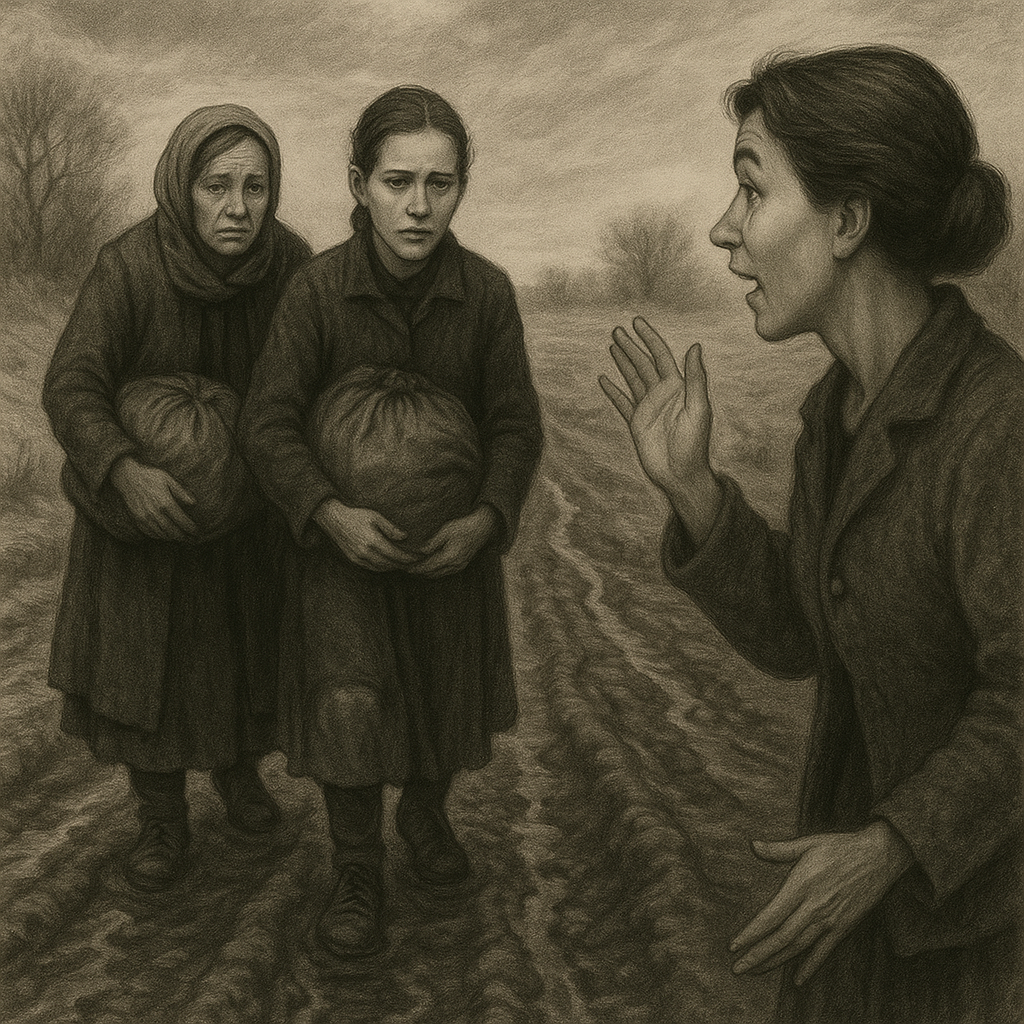
The road beyond her yard—usually just rutted—was now a mess of deep, water-filled tracks, thawed overnight into mud and slush.
Two women were coming from the direction of Cieksyn. One walked slowly, shoulders hunched. The other barely moved, her face thin and gray.
Both carried heavy bundles and looked too small for the world they were dragging behind them.
“Auntie! Nocia! Where are you coming from?” Genowefa called, running toward them. “Come to the house!”
They nodded, too tired to answer. Inside, they sat in silence until their hands stopped shaking.
“You came from Morgi?” Genia guessed.
Rozalia gave a slow nod. “Yes. Nocia wanted to bring her things...”
Genowefa looked at the bundles again and understood. Nobody spoke for a while.
“Maybe you should…” she started gently.
“No. It’s too late,” Innocenta said, not even lifting her eyes. Her cousin didn’t ask again. The decision was written all over her face.
A similar gloom had settled over Morgi. Earlier, Piotr had been heard muttering to himself:
“Oh head, oh head, what have you done—talked me into marrying.”
But he never went after his wife. Maybe it was illness. Maybe the winter. No one knew.
By mid-March, word reached Szczypiorno: Piotr Korycki was dead.
Nobody had expected it, not even the Śmigielskis, who had spoken with him just the night before.
They were woken at dawn by banging on the window. Outside stood two men from Nuna, Piotr’s cousins. They had come with a cart.
Without a word, they went into the room, gathered his belongings—everything—and loaded it up. Then they left.
“How did they know he was dead before I did, living next door?” Śmigielska asked, but no one had an answer.
There was no investigation. Not during wartime. The cause of death stayed a mystery.
At six in the morning, May 17, 1941, Innocenta gave birth to a girl in Szczypiorno. The child was tiny, too quiet. By the time she let out her first strong cry, everyone had already decided what had to be done.
The very next day, Marianna Oraczewska, the village midwife, bundled her up and carried her down the muddy road to Pomiechowo. In the church, Father Antoni Szewczak baptized the girl Jadwiga. Her godparents were Antoni Pawelski and Jadwiga Kamińska—family, of course.
Contrary to widespread fears, Jadwiga survived and even managed to diminish Third Reich property. During the war, Germans set up vehicle repair workshops in the Szczypiorno forests. To secure the site, they designated a protected zone, dubbed a “ghetto” by locals, interpreted as “Hitler will get nothing.” One afternoon, as little Jadwiga returned with her mother from Śniadówek, she spotted a stool by the road that she adored and insisted on taking. Seeing a nearby German notice her intent and step away, her mother allowed the unusual theft. The stool served the Kamiński family long after the war.
Winter brought more than cold. Jadwiga came down with pneumonia, and her breath grew shallower with each hour.
“Nocia, she’ll die,” Marianna whispered, standing by the stove.
“What can I do?” Innocenta said, rocking the child. “I’ve got no money. No medicine.”
“Go to the Germans. They have a doctor.”
“And if he poisons her?”
“If you wait, she’ll die anyway. Go!”
Innocenta didn’t argue. She dressed, bundled the child tight, and walked to the German post in the woods. She waited. Then asked. The doctor saw the girl.
By morning, Jadwiga opened her eyes. The fever had broken.
Not all contact with the occupiers was polite. Locals were forced into field work—rubber plants, weed pulling, whatever was needed. Innocenta went too, dragging along little Dziunia. So did the Kiliś girls.
The girl kept getting in the way. A German soldier noticed and came over.
“Why’s she here?” he asked in rough Polish.
“What am I supposed to do? A bitch carries her pups in her mouth. Should I leave my child behind?” Korycka snapped.
“Out! Take that brat and go!” he barked, not realizing he’d granted her silent wish.
Kazimierz Kiliś and Helena, childless, took in niece Stefania Helena to raise. Wacław had four children. One of them, Włodzimierz, became a priest in the Płock diocese. He never lived to see them grow up. In 1944, someone from the AK betrayed him. He was arrested and taken to Fort III in Pomiechowo, where he was killed. Some say he tried to run and was mauled by dogs.
But his mother never knew. Rozalia died on December 19, 1942.
Three months later, they buried Józefa. Tuberculosis took her after a long illness. Lucjan never forgave the family. He said her siblings could’ve done more. Could’ve cared for her better. They didn’t.
The village was lucky. The war passed without bombings, without fire. Only one man never came back. He’d told the Germans, “I’m non-denominational.”
That was enough. They arrested him. He died in a camp. No one else from Szczypiorno did.
“Flee! The front’s coming!” a German soldier shouted, rushing into the Chojnacki yard.
“Where can we flee when the Russians are already at Wola?” Antoni Szcześniak replied, viewing the Soviets as allies.
A few kilometers away, true dramas unfolded. A shell hit the Pawelski house in Śniadówek, passing through the door and severing thirteen-year-old Zdzisiu’s leg. He could have been saved but refused treatment and died. Jan Łęgowski was killed by shrapnel in the back while trying to leave on a cart.
Despite initial objections, as bullets flew overhead, all rushed to the shelter Antoni Szcześniak had built. Adults ran screaming, Dziunia “rode” on cousin Jurek Szcześniak’s back. Meanwhile, Marianna Chojnacka stayed to prepare food, a chicken ending in a pot for a broth later shared with hiding relatives.
After hours, as once a German, now Antoni called, “Russians are coming! Go welcome them!” All rushed outside, then to the road. Indeed, Soviet soldiers approached from Śniadówek.
“Go, greet them,” Uncle Antoni urged, pushing three-year-old Dziunia forward. She obediently approached.
“Good day.”
The soldier she addressed lifted her, replying courteously in Russian. Unfamiliar with the language, she turned to her mother, “What’s he saying?”
Fortunately, this ended their encounter with the “liberators,” though daily life forced interaction with those ready to sacrifice everything for the new occupiers.
“Mania, Mania, you won’t believe what I saw at the store!” Szcześniakowa exclaimed, dropping her shopping bag on a chair, bypassing her home to visit her sister.
“Tell me already,” Marianna urged.
“I go in, there’s a line. Normal. I wait. But ahead is Piątkowska.”
“So what?”
“Nothing yet, but guess why she was there? For two dekagrams of sugar!”
“Two?”
“Yes, two! She bragged to everyone, excited about guests from Nowy Dwór, needing sugar for tea to avoid shame!”
Chojnacka studied her sister, then both burst into laughter. Living frugally, they bought sugar by the kilogram. Calming down, Marianna teased, “You laugh at Piątkowska, but know who danced on a table when the ‘Pepeer’ cell formed in Nowy Dwór?”
“No! Not…”
“Yes, Piątkowski with your Antoś!”
Still, Antoni Szcześniak never served the new regime in Szczypiorno. Soon after, his family moved to Świeszyn near Koszalin, where he rose as chairman of the local council. Meanwhile, Stanisław Chojnacki, free of German troubles post-war, focused on Innocenta and her daughter. After several child-beating incidents, he took decisive action.
Marianna Chojnacka, with sisters Innocenta and Jadwiga, returned from Janowo, visiting brother Kazik, increasingly isolated since marriage. Unlike their father, he couldn’t assert himself, always yielding to his wife for peace. Once, deeply hurt, he visited Mani to vent, handing her a gold ring from the Bolshevik war.
“Take it, why let that ‘cow’ have it?” he said, giving her the long-hidden jewelry.
The sisters understood his situation, visiting him instead. From Janowo to Szczypiorno, they walked through forests, first a field path, then a stone road built by the Tsar for military transport, ending with a forest track between state and private woods. Only a shallow ravine separated them from the village. Once, the area was crisscrossed with deep ravines, forcing winding roads and even a viaduct over the Pomiechowo route west of the Wkra. Now, exiting the forest, the ravine was barely noticeable, marked only by a slight dip.
“What’s that noise?” one sister wondered aloud as they left the forest, intrigued by a strange clamor from a nearby plot. Curious, they hastened. Passing the Kielak’s first house, they saw nothing odd at Jadwiga’s, so the racket must have come from Marianna’s yard.
“Look at what that lunatic’s doing,” Jadwiga said to her elder sister, nodding ahead.
On a ladder against the room where Innocenta lived with her five-year-old daughter, Stanisław used a metal tool to rip off the last roof pieces, each falling with a crash. The women stopped by the fence, fearing Chojnacki. Usually calm and helpful, he became unpredictable in a rage.
Too busy, he ignored onlooker Czesław Kamiński and didn’t notice his wife and sisters. Descending, he muttered to his brother-in-law, “In a few years, when that wench grows up, men will flock here—why do I need this?”
The roofless were taken in by neighboring Kamińskis. Czesław salvaged materials to build a new room attached to his house.
Innocenta, over time, still earned by working for relatives. For short two- or three-day stints, she left her daughter with sister Jadwiga. The child hated this, sometimes running to the road, crying, “Dear Mommy, golden, blue! Don’t leave me!” It never worked, leaving Dziunia upset. Yet she didn’t accept it quietly, voicing opinions even as a toddler, sometimes offensively.
“Dziunia, how can you? God will be angry,” Aunt Chojnacka scolded when the niece responded improperly.
“God doesn’t see.”
“What do you mean ‘doesn’t see’? God sees all.”
The girl looked around theatrically—God wasn’t there. “No, He doesn’t,” she confirmed, already playing her game. Her spunky nature showed in Śniadówek, picking currants with “Grandpa” Władysław Pawelski, who filled a liter bucket with a generous top.
“Mommy, Mommy, look how beautiful!” Dziunia called, returning. Her mother, tempted, grabbed a handful to eat, sparking the child’s fury. Grandpa’s promise to gather more didn’t help; her distress lasted long, with lasting regret.
“At Szcześniaks’, Baśka’s wedding was to be,” Kazimierz Kiliś noted post-war. “We went with Ignacy, taking Nocia and Dziunia. Waiting for a transfer in Szczecin, we entered some ruins. Sadly, we let the child in.” The child remembered hair among the rubble but also wedding preparations, food, and plucking killed poultry.
Early education was at the local four-grade school, with catechism at Pomiechowo parish.
“Dziunia, who was with you?” her mother asked, returning from work.
“No one was with me.”
“What? Mrs. Korytowska heard you talking to someone.”
“No, I was just reading a book aloud,” the girl replied, a lover of reading, filling lonely hours.
 The path by the Kamiński fence was more a track than a road, a hundred meters from the real one. Left led to Śniadówek, then Cieksyn; right to the store, Mass in Pomiechowo, or the Pomiechówek office. At its crossing, Jadzia held a solemn funeral for her only toy doll, with Stasia Radomska, Teresa “Rojza,” and friends, led by Radomski. After a dignified burial with flowers, she returned to find the grave empty, suspecting Radomski’s silence hid a “resurrection.”
In June 1949, Jadwiga took her First Communion in Pomiechowo. During regular trips “for bread,” often to Bronisława Ostrowska, the young girl enjoyed the seven-kilometer walk to Uncle Stanisław Kiliś’s watermill by the Wkra, often going alone.
“Dziunia, wait, I’ll walk you back,” Stanisław offered his young cousin.
“I came alone, so I’ll return alone,” she replied.
Her wanderings also took her to Wrona for supplies. One November afternoon, Innocenta, late to meet her, found Dziunia peering along a ridge.
“Why so long?”
“I’m looking for another hare,” Jadzia said, handing over a bag.
“What hare?”
“The same one… didn’t you see, Mommy? It stood by the road…” She explained finding a hunter-killed hare, setting it to wait. “Why not take it? Someone’s likely found it,” Innocenta scolded, but it still waited. They walked home singing:
“Don’t cry, Karolciu, don’t cry, angel, / Not one Leon’s in the world, / Though he long stayed away from us, / But if he returns, he won’t leave… / Oh dear mother, he won’t return, / For my heart beats so… / Either a horse will throw him from the saddle, / Or a bad man will kill him. / Leon arrives, here after the wedding, / Guests revel in the salon, / And Karolina on another’s lap, / Another kisses her lips. / Oh Karolino, where’s your vow, / Where’s your whole enchantment? / You wrote in letters, come, oh come, / And now with another you’ve wed.”
The next day, with Aunt Kamińska, they prepared an unusual dinner.
Besides frequent visits to the Ostrowskis and Antoni Pawelski, Innocenta occasionally visited Władysław. Though his farm was on the way from Szczypiorno, visits were rare, causing friction. “They pass us to go to Antoś’s,” they complained. Neither Innocenta nor Dziunia fondly recalled it. Eight-year-old Dziunia remembered Aunt Marianna scolding her for climbing a fence to pick two nuts.
“She climbed somewhere!” Marianna shouted, adding, “You’ve nothing to do; at your age, I embroidered tapestries! I still have them.”
“Show me those tapestries,” the girl innocently asked, unaware of the impending fury.
The nut regret was partly justified, as Marianna skimped on her own children’s food. Julcia, Władysław’s sister, nine years younger, never married, deemed “slow” by family and deterred from suitors. She became an unpaid servant, first to Władysław, then Antoni. Despite mistreatment, she’d say, “This is for Władzio,” serving him the best potatoes. Yet she feared him, crying, “Władek will kill us,” when his wife threw son Heniek against a wall, causing a lifelong stammer after revival.
Julcia later moved to Antoni’s, two hundred meters away. Known as “dog’s filth” for his temper, Antoni was kinder. Still, she found no peace.
Pre-war, the wealthy Pawelskis attended many weddings. With eleven children, they hired trusted relatives to mind the farm. Eager poor kin obliged. “We’ll return tomorrow,” Marianna told cousin Lipkowa from Szczypiorno.
Stanisław, the eldest, asked, “What’ll we eat?”
“What do you mean ‘what’? Water’s in the ditch, potatoes in the cellar. You’ve food!” she snapped, leaving. After she left, he assured the stunned caregiver, “Auntie, don’t worry, we’ll manage.” With a spare key and roaming poultry, he made broth, hiding it from younger siblings to avoid trouble, as their toothless father ate roasted duck.
Władysław, despite his caring wife, prioritized his reputation. Returning from events, he’d drop a drunk Marianna in a ditch to sober up before home.
The harsh upbringing didn’t harm Władysław’s children, all reaching adulthood independently, unlike Antoni’s, overly cared for yet dying young.
In 1952, Innocenta and Dziunia faced big changes. After finishing four grades in Szczypiorno, they moved to Wrona permanently for better living and school access—five kilometers through forests versus Wrona’s shorter route.
“You know what happened to me?” a classmate yelled to Dziunia, excited. “Yesterday, I went to Kiliś’s rented land for apples. Sat in a tree, and Kiliś charged at me with a stick, bowing and shouting! I nearly fled!” Unaware, he targeted her uncle, Stanisław Kiliś, whose nervous tic caused head jerks. The prankster attended school seasonally, herding cows otherwise.
In Wrona’s fields, surrounded by trees, stood a wooden house from Jan Kiliś’s time. A path past its right end led to a small pond with a heavy treadmill. Opposite, farm buildings; across the path, a stone cellar hid smoked hams, sausages, and cream, delighting eleven-year-old Dziunia.
Harvest time disrupted this peace. Like all children, Jadwiga helped, leading a mare for a three-horse treadmill. The mare’s pickiness made Dziunia the only one to handle her. Soon, chafing forced her to lead by rein. A moment’s lapse let the 300-kg horse step on her foot.
Recovery was brief; days later, she remounted. The mare bolted through open gates. Only ducking saved her head from the beam. Frightened by Innocenta’s scream, it jumped a tank trap, stopping on a neighboring meadow.
Another memory: at the Ostrowskis’, abundant milk meant frequent pudding. One day, irritated, Innocenta cooked a pot, forcing Dziunia to eat it all. Decades later, she still felt nausea at the thought.
September 1952 marked Jadwiga’s new school in Wrona, using the schoolhouse and organist’s quarters. Despite eight kilometers daily, it seemed a better time—until January 20.
Days earlier, Stanisław Ostrowski awoke oddly, whispering, “Am I to die?” He described a dream of a lady in white urging readiness. It was forgotten—until later.
In January 1953, Innocenta had planned to stay the winter in Wrona. But the quiet days made her restless.
“Dolata will manage now,” she told Bronisława. “I’ll go back to Szczypiorno. Just until spring.”
The day before, she set off to Płońsk with Stanisław Ostrowski. Snow covered the roads, but they took his zajdki—small, narrow sleds, better suited for winter paths. Salamonowicz warned them: “Take the big ones.” They didn’t.
Jadwiga wanted to go. “No, Jadzia, you have school,” her mother said. She let her ride as far as the village center, then sent her back.
Jadwiga waited all afternoon in her uncle Kiliś’s house, sure her mother would return by train.
She never did.
At around four in the afternoon, just before the bridge in Szczytno, a military truck struck the sled. The crash scattered wood, sacks—and bodies.
Ostrowski died instantly.
Innocenta was still breathing. The soldiers put her on a Żuk and drove her to the hospital in Płońsk.
Near midnight, she opened her eyes and whispered:
“What will happen to my Dziunia?”
Then she was gone.
Jadwiga struggled to accept her mother’s death, awaiting a miracle until a nightmare of a bleeding-eyed Innocenta kneeling by her bed marked acceptance. Orphaned, her fate hung. Uncle Kazimierz Kiliś offered care, but his wife, already raising a niece, refused. The Chojnackis’ poverty—bees and Stanisław’s barbering—barred them. “Chojnacka picks potatoes through a ring for size,” farmers mocked, unaware of her even-cooking intent. Stanisław’s even wood-chopping aided heat; his later bridge work injury led to his death.
Jadwiga entered an orphanage but lived with Aunt Jadwiga Kamińska. In Szczypiorno, she attended Kosewo school, finishing basics. With nine Kamiński children, she worked summers, like carrying twelve-liter berry buckets with cousin Lech to sell, buying bread. Wanda’s father brought “Parisian” rolls and sausage on payday, thinly shared. Once, asking for more bread with sausage, “What are you doing?” Uncle Czesław scolded; “Uncle, I wanted it,” she explained. A new schoolbag gift sparked jealousy, rationalized over time.
Finishing seven grades in Kosewo, the Kamińskis moved to Brodowo, planning a plot for her, but it sold. She joined Pułtusk Pedagogical Lyceum, dreaming of teaching. A snow-stranded train led a soldier to aid her frostbitten face. Financial strain and ridicule—“One pair of underwear, washed nightly,” she recalled—pushed her to quit after a poor second-year report. Mieczysława’s unhelpful offer sealed it. She lived with the Szcześniaks in Świeszyn for eleven months, but health issues, including severe rheumatism from the damp climate, drove her back. At eighteen, she worked at a soda factory, then, via Edmund Pawelski, became a clerk in Błędówek, living with widowed Aunt Marianna Chojnacka.
“What are you doing?” Jadwiga asked, seeing Marianna force-feeding a chicken wheat upside-down. “I’m feeding her wheat, but she dug in Jankowska’s trash!” The chicken, seeking variety, caused a row; next day, they had broth.
Six-kilometer daily treks earned her a coat, hat, scarf, and soon boots. Feliks Otowski from Janowo brought hope, but his family rejected her as a penniless orphan. To spite him, she attended Barbara Jankowska’s wedding with Adam from Dziekanowo Polski, who visited often. They married November 23, 1963. Feliks’s furtive visit failed to stop it.
Priest Stanisław Mazurczak advised, “Teach him about God,” accepting 800 złoty without alcohol or a big party. Ice nearly derailed their December 26 church wedding, but they survived. Teściowie—hunchbacked father, witch-like mother—disapproved, bringing vodka. A Dziekanowo youth’s bottle grab led to, “That’s our problem. This bottle’s ours!” Food was shared equally post-wedding.
They moved to Dziekanowo, but teściowa’s control—changing a white tablecloth to checkered, reducing a 50-złoty offering to 40—strained ties. A priest’s outburst, “This’ll grow into a curse!” over a teen’s ignorance, and Zofia’s spying added tension. Meubel-buying disputes worsened relations.
Pregnant, Jadwiga pushed for independence. Adam chose her, moving to a Kępa Kiełpińska shed. Poverty loomed; she ate dry bread while he took sandwiches. Christmas with Chojnacka offered relief. A pig she raised was rehomed. A ghostly visitor presaged their son Piotr’s February 21, 1965, birth in Żoliborz, survived via sledge amid wolf attacks. Returning, they found a filthy home, Adam’s sister having used it.
Piotr’s January 5 christening in Łomianki proceeded with Wanda Kamińska and Ryszard Michalak after a last-minute switch. A communal flat offer was blocked by Zofia’s claim of two homes and a “pic.”
Our family tree has over 10,000 pieces of data. We also have around 75,000 photos and thousands of documents in our collection.
This tree can continue to grow only thanks to the interest and cooperation of close and distant relatives who, finding their relatives here, would like to share their information, photos or documents.
 English

